Showing posts with label books to read. Show all posts

Sunday, February 3, 2013

I Love Old Books


There is something about antiquity that sets my heart to racing. I believe it has much to do with my love of history. But a part of it has to do with stories.

Things that belong to the past but live in the present. I have a few of those. But yesterday, my collection took a giant leap for the better.


The Young Midshipman by G.A. Henty, Ishmael by E.D.E.N. Southworth, and Treasure Island by Robert Louis Stevenson


I was supposed to work all day. I won't go into detail about what kind of job I do because you all would shudder. Let's just say it's hard and takes all day. But yesterday my Dad decided to go home early.

The only thing that made it better was that he also let me stop at two antique shops. And I found these.

The cool thing is, aside from the fact that they are OLD, is that they are books I love, they were super cheap, and extremely rare to find. Well, I will clarify, Ishmael and the Henty are hard to find.


What I think is the neatest thing of all is that both of them are undated. I looked up Ishmael and all the web could tell me was that is was published c1900. Awesome, is it not? And the Henty has a beautiful inscription tucked inside the front cover which says "Josiah Mainwaring Bethany, Harrison County Missouri, a present from his daughter Elizabeth Spencer". {Which is really cool cause that middle name is unheard of, I don't know where Harrison Country is - though I suppose I could easily find out - and that must have been one loving daughter...}

Just imagine the stories these books could tell if only they could speak! Of nights up late, tucked in loving hands, a lamp set just right to reflect the crisp black lettering and well-worn pages... Oh, to know the life of a book! What an adventure...

All in all, it just made me happy. ;)


Monday, January 21, 2013

Guest Post by author Charley Robson


This week we are hearing from a new going-to-be-published author!!! She will be telling us all about her book {co-authored} that will be coming out soon. I am excited!


St Mallory’s Forever! is like the puppy that your  grandmother gives you on Christmas morning. It’s unexpected, amazing, the pride of your existence . . . but you have no idea how she snuck it into the house, or how you’re going to keep it from eating your English coursework.

In conversation, my co-author Miriam Joy and I call it “a young adult mystery”. The “young adult” is fairly obvious – both of us being at least several months off the official borders of adult-ness. But it’s a slippery appellation at best. What defines “young adult”? Does that mean it’s not suitable for younger readers? Are we allowed to have our characters hacking into the data files of MI6 under the guise of “young adult” entertainment?


Pinned Image


Sorry, I’m digressing. But my point is this: neither of us are greatly experienced in the “young adult mystery” department. We’ve both been writing a fair while, sometimes collaboratively, but both of us tend to stick to the realms of the supernatural – high fantasy, complete with neurotic sword-wielders, for me, and death and fairies (literally) for Miriam. So, suddenly, dealing with a real-world setting and a genre we’d only prodded and admired from afar was quite a challenge.
This is, of course, where the co-writing part comes in. By writing together, we stood a much better chance of actually creating a functioning plot – or at least having another head to bash against when we were really scuppered for ideas.

In fact, now that I think of it, I don’t think any one of us could have written St Mallory’s Forever! alone. Our publisher, and third head of our hydra-esque author entity, Mark, loves boarding school stories and has always had a bit of a dream about publishing one. If we hadn’t had him, we probably wouldn’t have even got started. Likewise, without Miriam, Mark and I would have been left scrabbling in pits of mutual confusion over the actual behaviour of Londoners. And without me? Well. Who else is going to tell them which way up a lacrosse stick goes? 

So this was us, hammering out tentative chapters and sending them flying through cyberspace once or twice a week. We got better as we got going, of course, and the editing process was surprisingly easy. If one of us didn’t catch that errant apostrophe lurking in Chapter Twelve, you can bet one of the others would (and slay it mercilessly into the bargain). Continuity was a bit squicky, I’ll admit, but you can blame exams, moving house, and various ill-timed illnesses for that.

Writing with other people is great fun, especially for a profession that is, archetypally, pretty lonely. Miriam and I had a bit of trouble adjusting, both being horrific control freaks, but before long we were too busy questioning the origin of references we didn’t understand and wondering if anyone actually remembered the name of the Physics teacher.


Pinned Image


Apologies for the slightly disorganised nature of this post. I did try to keep it all in order, but writing a book is, going back to my first analogy, like trying to explain to your teacher why your pockets are full of mangled tennis balls after being woken up at three in the morning for an early morning game of catch by a damp tongue and a distinct smell of pilfered dog biscuits.

Thus, in order not to appear completely useless, I’ll leave you with a few little tidbits of advice that I’d give to myself at the beginning of the St Mall’s adventure:

Pinned Image1 – Listen to the experts. Even if you don’t have an incredible Obi Wan of a co-author, there are plenty of amazing blogs out there, done by people who break down the complications of the world for the newbies.  

2 – Balance your time. Miriam and I wrote most of the first draft of St Mallory’s during two of the most stressful years of our schooling, so we both had to learn to balance the immediate needs of our grades against the long-term (and much more exciting) prospect of bashing out another chapter of the novel.

3 – Enjoy yourself! Don’t think that just because it’s such a long and painful process that it’s got to suck harder than a cyclone-powered Dyson. Give yourself little treats and rewards, talk about it with your friends and family, and enjoy the journey! If you don’t enjoy writing it, nobody’s going to have much fun reading it, are they?

Thanks to all for reading, and special big thanks to the lovely blog hostess for letting me invade her pristine corner of the internet and sully it with my blithering.
 
If you want to know more about St Mallory’s Forever!, you can check out its official blog, its Facebook page!, You can also check out mine or Miriam’s blog!


~ Charley R
 
 
{Charley sent me a beautiful copy of their book cover, but because of blogger's refusal to behave, I cannot upload it. But please head over to THIS site to see both it and learn more about the book.}


Miriam Joy

Photo by Andy WilsdonMiriam Joy is the youngest member of the St Mallory’s Forever! multi-headed author entity. She has lived in South-East London all her life, working through the state education system and trying to appear as normal as a fangirling nerd ever can (she is, after all, a proud contributor to the Hamlet fandom). Recently, she became the assistant to the Teens Can Write Too! blog, which basically means answering emails and pretending to know what she’s talking about.
As well as writing, she also does ballet and archery, plays three instruments (violin, flute and piccolo), makes YouTube videos, blogs, and is learning two dead languages and a made-up one on top of her schoolwork. Despite this, she still manages to spend far too much time on Tumblr, which has led to an accumulation of quotes and facts about actors or TV shows that she will never, ever need, but likes to know anyway.
She loves mythology, especially Celtic and Norse. Her music taste varies from Shostakovich to My Chemical Romance, taking in a lot of the stuff in between, although for writing she usually prefers film or TV soundtracks.
Her short story The Eagle Child was published in volume one of the Saffina Desforges Presents… Coffee Break Collections in November 2011.

Charley Robson

Charley RobsonCharley Robson has a more unusual background: a proud ‘army brat’, she has lived on every major continent on Earth and is currently attending her thirteenth school, a boarding school for girls in Dorset, South England. She has tried and failed to learn several languages (though will happily insult you in both Arabic and Latin) and has met many weird and wondering people during her travels.
Her deeply-seated loathing for all things requiring a calculator means she spends most of her time reading, picking her teeth with five-page essays, covering her fingers in ink, and poking philosophical holes in reality. Aside from this and writing, which goes without saying, Charley also enjoys long walks, acting (she has been cast as nothing but villains since the age of seven), singing and watching Doctor Who. Her musical tastes range from films soundtracks to rock bands to Celtic music, and back again. She’s even been known to listen to a Disney song from time to time.
Charley is also a fairly prolific poet, and one of her poems was awarded a place in the top 20 of a Daily Telegraph poetry competition in 2010. She’ll try her hand at most types of writing, though, including articles for her school magazine and, in 2012, a pantomime for performance in the annual school Drama competition.
Charley’s short story Darkness to Light was published in the second volume of the Saffina Desforges Presents… Coffee Break Collections in February 2012.


Saturday, January 5, 2013

On My Bookshelf: Eragon


One boy….
    One dragon….
          A world of adventure.

When Eragon finds a polished blue stone in the forest, he thinks it is the lucky discovery of a poor farm boy; perhaps it will buy his family meat for the winter. But when the stone brings a dragon hatchling, Eragon soon realizes he has stumbled upon a legacy nearly as old as the Empire itself.
Overnight, his simple life is shattered, and he is thrust into a perilous new world of destiny, magic, and power. With only an ancient sword and the advice of an old storyteller for guidance, Eragon and the fledgling dragon must navigate the dangerous terrain and dark enemies of an Empire ruled by a king whose evil knows no bounds.
Can Eragon take up the mantle of the legendary Dragon Riders? The fate of the Empire may rest in his hands…


By Christopher Paolini
Young Adult
Genre: fantasy


Pinned Image


My thoughts:

A cruel king.
A dragon hatchling.
A boy with an unknown lineage.
And a battle of good vs. evil.

Sounds like a novel to me. 

Eragon: a creative writer’s masterpiece.

The actual writing behind Eragon might be a bit plain and primitive. The main character might be cliché and a little too brilliant at times. But one thing is for sure. This is a story, a tale, that leads you on an adventure of a lifetime.

I picked Eragon up off the shelf with one goal in mind. I have read little fantasy, still less popular books, and I felt I had a need to fill in a bit of that void. And Eragon did not disappoint me.

Of course, you all now know my disdain for magic. {Found here} I knew beforehand that it would be everywhere. It is used, frequently, in Eragon and the following series. It is a drawback that will probably mean the Inheritance series will never nestle comfortably on my bookshelf. I borrowed them. And I will probably always only borrow them.


Pinned Image
 

BUT, I do not regret reading Eragon. It is a masterful story, done so well, made so intriguing, that you tend to forget that Paolini had yet to develop a very compelling style. Story was all you needed. And story he gives.

Do you want to read Eragon? I don’t know. It is HUGE. And I mean, big. But if that doesn’t daunt you, and you want a good story, and you don’t mind magic, I’d say you’d enjoy it very much.

And if you are writing a fantasy, read it. I will honestly say that Eragon taught me a great many things about writing a fantasy novel. Things I will never regret learning. From creating a magnificent landscape to developing assorted people groups to starting a world off brand new, yet making it ancient, I gleaned so much I could never write it all down.  And that is a double plus! ++


Saturday, December 15, 2012

On My Bookshelf: The Girl in the Glass


Renaissance is a word
with hope infused in every letter.
 
 
Since she was a child, Meg has dreamed of taking a promised trip to Florence, Italy, and being able to finally step into the place captured in a picture at her grandmother's house. But after her grandmother passes away and it falls to her less-than-reliable father to take her instead, Meg's long-anticipated travel plans seem permanently on hold.
 
When her dad finally tells Meg to book the trip, she prays that the experience will heal the fissures left on her life by her parents' divorce. But when Meg arrives in Florence, her father is nowhere to be found, leaving aspiring memoir-writer Sophia Borelli to introduce Meg to the rich beauty of the ancient city. Sophia claims to be one of the last surviving members of the Medici family and that a long-ago Medici princess, Nora Orsini, communicates with her from within the great masterpieces of the Italian Renaissance.
 
When Sophia, Meg, and Nora's stories intersect, their lives will be indelibly changes as they each answer the question: What if renaissance isn't just a word? What if that's what happens when you dare to believe that what is isn't what has to be?
 
 
The Girl in the Glass: A Novel
 
 
By Susan Meissner
Genre: historical fiction/fiction

My thoughts:

I was a little skeptical when I picked this book up. I never read anything by Meissner before and the backcover blurp appeared almost a little too simple, cliché, and childish for a young adult/adult book. Not to mention a bit weird. I mean, seriously, no one can talk to someone of the past through paintings and sculptures. You can imagine how surprised and pleased I was to find it a most refreshing read. 

Meissner uses new phrasing, to-the-point, yet moving dialogue, and a description that enchants as much as it sucks you into her world. Her story, revolving around book editor, Marguerite (Meg) Pomeroy, is one of mystery and history (definitely endearing for me). Meg has had one dream her whole life: to visit the ancient city of Florence. Ever since her Italian grandmother passed away, her father promised to take her as a graduation present. But she has long since passed high school, and then college, and still they have never taken the promised trip, and now she has a life immersed in the publication business. Life goes on day to day, and though she still dreams of going to Florence, reminisces about her past longings and memories of her grandmother, she is resigned to the fact that her father just might not pull through and take her. And then, out of the blue, it happens.

Just not the way she ever expected. And it thrusts her on an adventure that will change her forever.

Probably the thing that singles this novel out the most is Meissner’s powerful way with words. Not only do you believe with every ounce of your being that Meg wants to go to Florence, that she should go to Florence, but you want to go too, to see the things she pictures, the settings she paints, the artwork she describes... Not only do you believe Sophia’s claim of hearing Nora, but you hear her too. And you want to tell the world. There is something almost magical in the way Meissner speaks, like a beautiful lilt of poetry, a last spec of color dancing on the horizon of a dark world. It is captivating.

There was only one drawback to the book. Meg is needy, in many ways, all relatable and understandable, but throughout the books she struggles between “picking” one of three men. By the end of the book, the reader is more or less tired about her wishy-washy desires for love, yet inability to just sit down and choose.

Still, it is a beautiful story about restoration, relationships, and learning to keep your imagination and reality in two places.

What does one do with a heart that has been broken? One might look for a bonding agent that will fuse all the pieces back together. Or one might learn to live among the shards.
Or one might be tempted to sweep up the bits and toss them and be done with hearts. ~ Nora


Pinned Image


Sunday, October 28, 2012

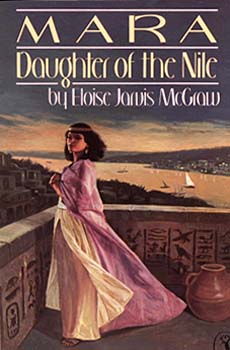
On My Bookshelf: Mara, Daughter of the Nile


Mara is a proud and beautiful slave girl who yearns for freedom. In order to gain it, she finds herself playing the dangerous role of double spy for two arch enemies - each of whom supports a contender for the throne of Egypt.
 
Against her will, Mara finds herself falling in love with one her masters, the noble Sheftu, and she starts to believe in his plans of restoring Thutmose III to the throne. But, just when Mara is ready to offer Sheftu her help and her heart, her duplicity is discovered, and a battle ensues in which both Mara's life and the fate of Egypt are at stake.


 Author: Eloise Jarvis McGraw
Any Age
Setting: Ancient Egypt

"Look out for yourself my girl. Nobody else will."

My thoughts:


The first time I met Mara, my mother sat down in the living room, cracked open a well-worn copy with the haunted picture of a lonely maid on the front cover, and began reading the story aloud to me and my little brothers and sisters right before bed. I am sure it was a pretty picture, all five of us cuddled up in thick, warm comforters, mugs of hot chocolate cradled in our little hands, wide-eyed listeners to a story of a land far away.

I don't know how many books my parents read aloud to me as a child. They are too numerous to count.

But one thing I do know.

Mara stuck with me.


Mara is proud. She is strong. She is witty. She lives in a world that is cruel and ruthless. She knows nothing of kindness and sympathy. And she pretends she needs none of it.

The character of Mara is solid flesh and blood. Her tears, her struggles, her victories, are living and breathing inside you. Her spirited fire and wit sends you into peals of laughter and keep you on pins and needles to find out how she will finagle her way out of the next peril. Danger is real. Mara flirts with death.

The things is, she knows it, and laughs in its face.

I have read almost all of Eloise Jarvis McGraws young adult fiction and have come to one conclusion. She uses a link to the emotions of her readers that is at once invisible and powerful. Every desire in her characters is a fire-breathing dragon in your belly. Her writing leaves you sitting up late, a flashlight clutched in a sweaty palm, glued to the pages. It is a style that captures sudden and permanent interest.

Mara, Daughter of the Nile, is written in a way that will never die. Her vivid descriptions of the cities, palace, river, and whole of Egypt settle you deep into the place where your characters live. You see The Silver Beetle, the ship that carried Mara on the Nile, you see the labyrinth of palace Hatshepsut calls her court, you see the inn where the rebels meet. You can almost reach out and touch the rooms where Mara lives.

Historically, the books is flawlessly accurate, allowing for some storyline liberation's (there was no little blue-eyed interpreter that saved the throne of Thutmose III). The very fact that history is sketchy of just what did happen between Hatshepsut and Thutmose proves what a masterful storyteller McGraw is. The Black Land is as real to us as it is to Mara and those trapped in that hot summer month where rebellion takes its final step.

Mara is not a romance book. I am not particularly fond of too perfect young men and weepy, desperate girls. The romantic angle of this book is both unusual and intriguing. And the story does not focus on the emotions beginning to stir in the hearts of the characters, but rather on what is bringing them together.

The real heart and soul behind Mara is found tucked in golden lines scattered throughout the book. This is a book about deciding what is worth fighting for, living for, and dieing for.

Mara is a book you will always find on my bookshelf. It is one to leave deep and lasting marks on your heart.

 
Pinned Image


Wednesday, October 10, 2012

On My Bookshelf: The Twelve Trademarks of Great Literature


My father bought this book, The Twelve Trademarks of Great Literature, for me about six months ago at a conference. When I first saw it, I thought it was going to be another let-me-tell-you-what-is-a-good-book-and-what-is-not pamphlet that had been stretched and lengthened into as many pages as the publishers could manage. I just knew it would trip all over itself with redundant phrases and ideas and tell me a bunch of facts I already knew.

Because of that, I didn't open it for five months. When I did, I read the introduction, stuck a bookmark in it, stuck it under the twenty other books on my nightstand, and forgot all about it.


Two nights ago, I pulled it out of the stack and began flipping through it. After a minute, I was glued to the pages.

 
The Twelve Trademarks of Great Literature:
 
1. The dogma is the drama.
2. Maintains proportion and perspective.
3. Maintains the appropriate pace.
4. Demonstrates an economy of words.
5. Flows uninterruptedly.
6. Unfailingly chooses the mot juste.
7. Makes the reader sympathize with at least one character.
8. Rewards attentive re-reading.
9. Shows rather than tells.
10. Expresses the inexpressible.
11. Moves you.
12. Creates with a distinct voice.


When I first read this list, my jaw dropped. Not only is it 100% correct, but it leaves so much room for personal opinion, while stating irrefutable truth. The writing is very clear and speaks directly to the issues it brings up.

I am excited to finish this book now and can't wait to share what I learn!


Pinned Image