Showing posts with label On My Bookshelf. Show all posts

Saturday, January 5, 2013

On My Bookshelf: Eragon


One boy….
    One dragon….
          A world of adventure.

When Eragon finds a polished blue stone in the forest, he thinks it is the lucky discovery of a poor farm boy; perhaps it will buy his family meat for the winter. But when the stone brings a dragon hatchling, Eragon soon realizes he has stumbled upon a legacy nearly as old as the Empire itself.
Overnight, his simple life is shattered, and he is thrust into a perilous new world of destiny, magic, and power. With only an ancient sword and the advice of an old storyteller for guidance, Eragon and the fledgling dragon must navigate the dangerous terrain and dark enemies of an Empire ruled by a king whose evil knows no bounds.
Can Eragon take up the mantle of the legendary Dragon Riders? The fate of the Empire may rest in his hands…


By Christopher Paolini
Young Adult
Genre: fantasy


Pinned Image


My thoughts:

A cruel king.
A dragon hatchling.
A boy with an unknown lineage.
And a battle of good vs. evil.

Sounds like a novel to me. 

Eragon: a creative writer’s masterpiece.

The actual writing behind Eragon might be a bit plain and primitive. The main character might be cliché and a little too brilliant at times. But one thing is for sure. This is a story, a tale, that leads you on an adventure of a lifetime.

I picked Eragon up off the shelf with one goal in mind. I have read little fantasy, still less popular books, and I felt I had a need to fill in a bit of that void. And Eragon did not disappoint me.

Of course, you all now know my disdain for magic. {Found here} I knew beforehand that it would be everywhere. It is used, frequently, in Eragon and the following series. It is a drawback that will probably mean the Inheritance series will never nestle comfortably on my bookshelf. I borrowed them. And I will probably always only borrow them.


Pinned Image
 

BUT, I do not regret reading Eragon. It is a masterful story, done so well, made so intriguing, that you tend to forget that Paolini had yet to develop a very compelling style. Story was all you needed. And story he gives.

Do you want to read Eragon? I don’t know. It is HUGE. And I mean, big. But if that doesn’t daunt you, and you want a good story, and you don’t mind magic, I’d say you’d enjoy it very much.

And if you are writing a fantasy, read it. I will honestly say that Eragon taught me a great many things about writing a fantasy novel. Things I will never regret learning. From creating a magnificent landscape to developing assorted people groups to starting a world off brand new, yet making it ancient, I gleaned so much I could never write it all down.  And that is a double plus! ++


Sunday, December 23, 2012

On My Bookshelf: Starflower


The Black Dogs are on the Hunt,
But who is their Prey? 


When a cursed dragon-witch kidnaps fairest Lady Gleamdren, the Bard Eanrin sets boldly forth on a rescue mission . . . and a race against his rival for Gleamdren’s favor. Intent upon his quest, the last thing the immortal Faerie needs is to become mixed up with the troubles of an insignificant mortal.

But when he stumbled upon a maiden trapped in an enchanted sleep, he cannot leave her alone in the dangerous Wood Between. One waking kiss later, Eanrin suddenly finds his story entagled with that of young Starflower. A strange link exists between this mortal girl and the dragon-witch. Will Starflower prove the key to Lady Gleamdren’s rescue? Or will the dark power from which she flees destroy both her and her rescuer?


By Anne Elisabeth Stengl
Young adult
Genre: fantasy
 
"How she had loved her city, once upon a time. How she hated it now. But it was hers more than ever. Hate was a fearful binding." ~ Hri Sora
 
My thoughts...
 
 
I was hesitant to decide I liked this book the first hundred pages in. It was a little dry in places and switched point of view so many times it was confusing. But when Stengl began to unwind the tragic story of Starflower, maiden of the dark New World, I was caught. She spins a beautiful web of deceit, ancient curses, and weakness. Starflower's world needs a deliverer. And a most unlikely one threads through the pages ~ with the guidance of the Hound, One Who Names Them, the Giver of Songs, Lumil Eliasul, who leads down a path they do not wish to go . . . but need with everything they are.

I will be point blank honest. There are parts of this book I hate. But for no reason any of you will.
I do not believe magic is good. In any form. It cannot be. God has decreed that so. And it can be used in a masterful way, showing that. My good friend Mary has portrayed that perfectly in her novel, Son of the Shield. In a battle of good and evil, what better way to show the evilness of the enemy by the dark power they wield? But to have good magic? Impossible.
 
I know, I know. Half of you are gagging, the other half cringing. What I say is revolutionary. Maybe you will disown me. Maybe you will prissily un-follow my blog and pretend you never heard of me. But I must tell the truth. And I will stick to it. And you know, I don’t care if you do like magic. That is your choice. It is none of my concern. I just wanted to let you know where my discomfort comes from. 
 
So anyway, there are parts of this book I hate. Being, as it were, a Faerie, Earnin is magic. Or magical. He can change form, smell danger, sense the approach of others, and many other talents through the vitality of the magic coursing in his blood. And the others around him are all the same. In fact everyone is, except the mortals. And that is why it did impress me, that not once, was magic used, as if were. Magic just, well, was.
 
Well, that aside, the book did not start off with the bang I expected. It was dry. It was long. And it was not cleverly written, so often changing point of view between a vast cast of characters, that it often left you hanging empty and confused.
 
But {ah yes, there always is a but, thank goodness}, the moment the story of Starflower began to untangle, the book caught me. And something more. The purpose of the book.
 
It is beautiful. In a picture analogy so perfect and so heartrending, Stengl molds a story so compelling and so realistic, no one doubts why the characters take the steps they take nor change the way they do.
 
So would I recommend it to my friends?
 
No.
 
Would I say you should read it?
 
Sure.
 
Yes, I am quite bi-polar and I know it. :D


Saturday, December 15, 2012

On My Bookshelf: The Girl in the Glass


Renaissance is a word
with hope infused in every letter.
 
 
Since she was a child, Meg has dreamed of taking a promised trip to Florence, Italy, and being able to finally step into the place captured in a picture at her grandmother's house. But after her grandmother passes away and it falls to her less-than-reliable father to take her instead, Meg's long-anticipated travel plans seem permanently on hold.
 
When her dad finally tells Meg to book the trip, she prays that the experience will heal the fissures left on her life by her parents' divorce. But when Meg arrives in Florence, her father is nowhere to be found, leaving aspiring memoir-writer Sophia Borelli to introduce Meg to the rich beauty of the ancient city. Sophia claims to be one of the last surviving members of the Medici family and that a long-ago Medici princess, Nora Orsini, communicates with her from within the great masterpieces of the Italian Renaissance.
 
When Sophia, Meg, and Nora's stories intersect, their lives will be indelibly changes as they each answer the question: What if renaissance isn't just a word? What if that's what happens when you dare to believe that what is isn't what has to be?
 
 
The Girl in the Glass: A Novel
 
 
By Susan Meissner
Genre: historical fiction/fiction

My thoughts:

I was a little skeptical when I picked this book up. I never read anything by Meissner before and the backcover blurp appeared almost a little too simple, cliché, and childish for a young adult/adult book. Not to mention a bit weird. I mean, seriously, no one can talk to someone of the past through paintings and sculptures. You can imagine how surprised and pleased I was to find it a most refreshing read. 

Meissner uses new phrasing, to-the-point, yet moving dialogue, and a description that enchants as much as it sucks you into her world. Her story, revolving around book editor, Marguerite (Meg) Pomeroy, is one of mystery and history (definitely endearing for me). Meg has had one dream her whole life: to visit the ancient city of Florence. Ever since her Italian grandmother passed away, her father promised to take her as a graduation present. But she has long since passed high school, and then college, and still they have never taken the promised trip, and now she has a life immersed in the publication business. Life goes on day to day, and though she still dreams of going to Florence, reminisces about her past longings and memories of her grandmother, she is resigned to the fact that her father just might not pull through and take her. And then, out of the blue, it happens.

Just not the way she ever expected. And it thrusts her on an adventure that will change her forever.

Probably the thing that singles this novel out the most is Meissner’s powerful way with words. Not only do you believe with every ounce of your being that Meg wants to go to Florence, that she should go to Florence, but you want to go too, to see the things she pictures, the settings she paints, the artwork she describes... Not only do you believe Sophia’s claim of hearing Nora, but you hear her too. And you want to tell the world. There is something almost magical in the way Meissner speaks, like a beautiful lilt of poetry, a last spec of color dancing on the horizon of a dark world. It is captivating.

There was only one drawback to the book. Meg is needy, in many ways, all relatable and understandable, but throughout the books she struggles between “picking” one of three men. By the end of the book, the reader is more or less tired about her wishy-washy desires for love, yet inability to just sit down and choose.

Still, it is a beautiful story about restoration, relationships, and learning to keep your imagination and reality in two places.

What does one do with a heart that has been broken? One might look for a bonding agent that will fuse all the pieces back together. Or one might learn to live among the shards.
Or one might be tempted to sweep up the bits and toss them and be done with hearts. ~ Nora


Pinned Image


Sunday, October 28, 2012

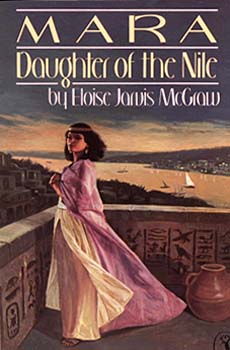
On My Bookshelf: Mara, Daughter of the Nile


Mara is a proud and beautiful slave girl who yearns for freedom. In order to gain it, she finds herself playing the dangerous role of double spy for two arch enemies - each of whom supports a contender for the throne of Egypt.
 
Against her will, Mara finds herself falling in love with one her masters, the noble Sheftu, and she starts to believe in his plans of restoring Thutmose III to the throne. But, just when Mara is ready to offer Sheftu her help and her heart, her duplicity is discovered, and a battle ensues in which both Mara's life and the fate of Egypt are at stake.


 Author: Eloise Jarvis McGraw
Any Age
Setting: Ancient Egypt

"Look out for yourself my girl. Nobody else will."

My thoughts:


The first time I met Mara, my mother sat down in the living room, cracked open a well-worn copy with the haunted picture of a lonely maid on the front cover, and began reading the story aloud to me and my little brothers and sisters right before bed. I am sure it was a pretty picture, all five of us cuddled up in thick, warm comforters, mugs of hot chocolate cradled in our little hands, wide-eyed listeners to a story of a land far away.

I don't know how many books my parents read aloud to me as a child. They are too numerous to count.

But one thing I do know.

Mara stuck with me.


Mara is proud. She is strong. She is witty. She lives in a world that is cruel and ruthless. She knows nothing of kindness and sympathy. And she pretends she needs none of it.

The character of Mara is solid flesh and blood. Her tears, her struggles, her victories, are living and breathing inside you. Her spirited fire and wit sends you into peals of laughter and keep you on pins and needles to find out how she will finagle her way out of the next peril. Danger is real. Mara flirts with death.

The things is, she knows it, and laughs in its face.

I have read almost all of Eloise Jarvis McGraws young adult fiction and have come to one conclusion. She uses a link to the emotions of her readers that is at once invisible and powerful. Every desire in her characters is a fire-breathing dragon in your belly. Her writing leaves you sitting up late, a flashlight clutched in a sweaty palm, glued to the pages. It is a style that captures sudden and permanent interest.

Mara, Daughter of the Nile, is written in a way that will never die. Her vivid descriptions of the cities, palace, river, and whole of Egypt settle you deep into the place where your characters live. You see The Silver Beetle, the ship that carried Mara on the Nile, you see the labyrinth of palace Hatshepsut calls her court, you see the inn where the rebels meet. You can almost reach out and touch the rooms where Mara lives.

Historically, the books is flawlessly accurate, allowing for some storyline liberation's (there was no little blue-eyed interpreter that saved the throne of Thutmose III). The very fact that history is sketchy of just what did happen between Hatshepsut and Thutmose proves what a masterful storyteller McGraw is. The Black Land is as real to us as it is to Mara and those trapped in that hot summer month where rebellion takes its final step.

Mara is not a romance book. I am not particularly fond of too perfect young men and weepy, desperate girls. The romantic angle of this book is both unusual and intriguing. And the story does not focus on the emotions beginning to stir in the hearts of the characters, but rather on what is bringing them together.

The real heart and soul behind Mara is found tucked in golden lines scattered throughout the book. This is a book about deciding what is worth fighting for, living for, and dieing for.

Mara is a book you will always find on my bookshelf. It is one to leave deep and lasting marks on your heart.

 
Pinned Image


Wednesday, October 10, 2012

On My Bookshelf: The Twelve Trademarks of Great Literature


My father bought this book, The Twelve Trademarks of Great Literature, for me about six months ago at a conference. When I first saw it, I thought it was going to be another let-me-tell-you-what-is-a-good-book-and-what-is-not pamphlet that had been stretched and lengthened into as many pages as the publishers could manage. I just knew it would trip all over itself with redundant phrases and ideas and tell me a bunch of facts I already knew.

Because of that, I didn't open it for five months. When I did, I read the introduction, stuck a bookmark in it, stuck it under the twenty other books on my nightstand, and forgot all about it.


Two nights ago, I pulled it out of the stack and began flipping through it. After a minute, I was glued to the pages.

 
The Twelve Trademarks of Great Literature:
 
1. The dogma is the drama.
2. Maintains proportion and perspective.
3. Maintains the appropriate pace.
4. Demonstrates an economy of words.
5. Flows uninterruptedly.
6. Unfailingly chooses the mot juste.
7. Makes the reader sympathize with at least one character.
8. Rewards attentive re-reading.
9. Shows rather than tells.
10. Expresses the inexpressible.
11. Moves you.
12. Creates with a distinct voice.


When I first read this list, my jaw dropped. Not only is it 100% correct, but it leaves so much room for personal opinion, while stating irrefutable truth. The writing is very clear and speaks directly to the issues it brings up.

I am excited to finish this book now and can't wait to share what I learn!


Pinned Image